Ready Before It Happens – The Role of Businesses in Sweden’s Total Defence
Sweden is operating in a new security reality. The threats are not always visible and rarely formally declared, yet they are persistent. Hybrid influence operations, cyberattacks, infrastructure mapping and strategic dependency-building are not future scenarios — they are ongoing activities.
Preparedness is therefore not a distant concern. It is a present responsibility.
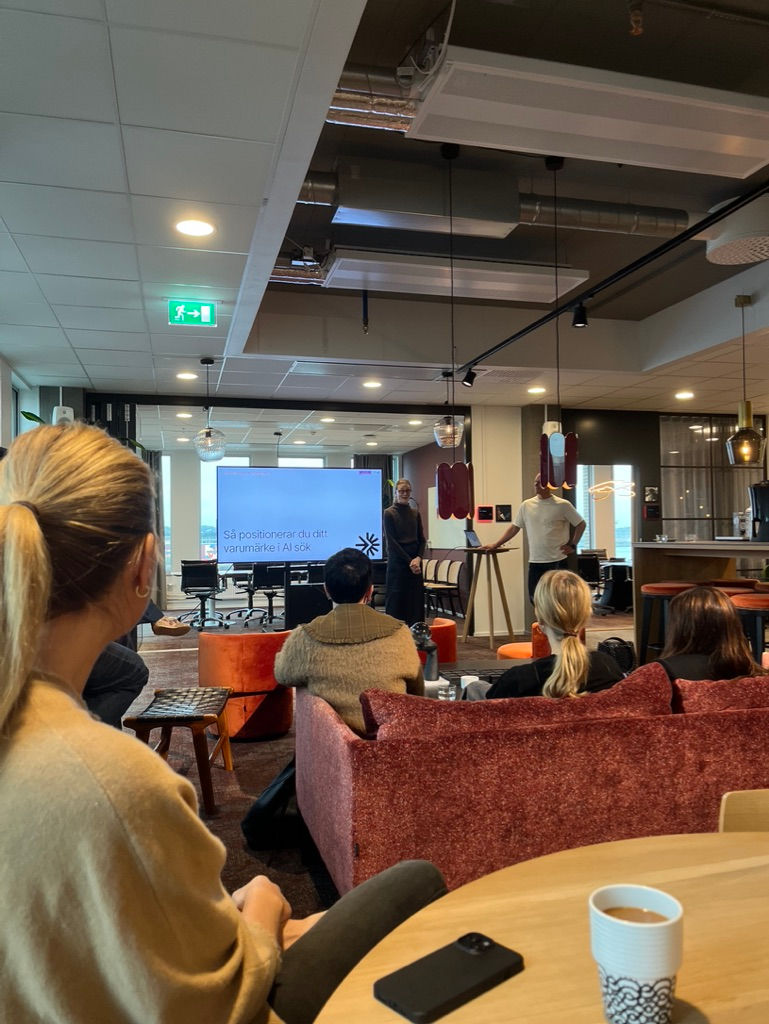
At the event “Ready When It Matters – How Companies Build Preparedness”, one message stood out clearly: total defence is not a separate military structure. It is the combined ability of society to continue functioning under pressure. And that ability largely resides within the private sector.
As one speaker put it: we should not be ready when something happens — we should be ready before it happens.

Hybrid conflict reshapes preparedness
Referring to Sweden’s Military Intelligence and Security Service (MUST) assessments, the opening keynote described a landscape where conflicts rarely begin with clear military escalation. Instead, we see cyber intrusions, distributed denial-of-service attacks, disinformation campaigns and systematic mapping of critical infrastructure.
Vulnerabilities are identified long before they are exploited. Supply chains, ownership structures and digital dependencies become part of the strategic environment.
In this context, independence is not a political slogan — it is an operational capability. The ability to maintain function despite disruption is what ultimately defines resilience.
Industry and innovation as strategic assets
A recurring theme throughout the event was that industry is one of Sweden’s strongest defence assets.
The technology sector today contributes more to GDP and exports than traditional heavy industry. Much of Sweden’s innovation capacity resides in small and medium-sized enterprises (SMEs), where adaptability and speed are often greatest.
The comparison to Ukraine illustrated how dramatically innovation cycles can shorten under pressure. When circumstances change rapidly, organisations capable of accelerating development and scaling production gain decisive advantage.
The organisation that adapts fastest retains the greatest freedom of action.
Preparedness, in this sense, is not a passive precaution. It is an active investment in capability.
Logistics as a bloodstream — and AI as an immune system
A particularly tangible example of resilience in practice was presented by Sara Ali, CEO of LogTrade Technology.
She described logistics networks as the bloodstream of society. Through these networks flow pharmaceuticals, industrial components, defence materials and everyday consumer goods. At the same time, vast amounts of data are generated — delivery routes, priorities, consumption patterns and infrastructure dependencies.
In the wrong hands, such data can enable detailed mapping of societal vulnerabilities.
To address this, LogTrade uses algorithm-driven distribution models designed to introduce unpredictability into logistics flows. Artificial intelligence continuously monitors for disruptions and dynamically reroutes deliveries when necessary. The system functions like an immune system: detecting anomalies, responding in real time and maintaining circulation even when disturbances occur.
A key principle is data ownership and controlled access. Not every actor in a supply chain requires full visibility. Limiting data exposure to what is operationally necessary reduces systemic risk without compromising efficiency.
Resilience here is not merely about backup systems. It is about intelligent systems that adapt and continue operating under stress.

Civil defence and business continuity
Peter Jadersjö from the County Administrative Board of Västra Götaland highlighted the importance of civil preparedness and supply resilience. In a wartime scenario, Sweden’s infrastructure and logistics flows would likely become targets for disruption — even if active combat occurs elsewhere.
Companies that can continue operating in such circumstances become critical contributors to national stability.
This is not only a matter of national security; it is also a strategic business consideration. Demand patterns change during crises. New needs emerge. Organisations that have analysed their operational dependencies and prepared contingency plans in advance are better positioned to adapt and continue delivering value.
Collaboration between businesses, municipalities, regions and national authorities is essential. Trust, contact pathways and mutual understanding cannot be established overnight. They must be built proactively.
Preparedness is therefore both relational and structural.
Cyber resilience as a foundation
Underlying all these discussions is a fundamental enabler: digital resilience.
The military concept of C4ISR — Command, Control, Communications, Computers, Intelligence, Surveillance and Reconnaissance — describes the digital nervous system of modern defence. Without secure IT environments, reliable communication and trustworthy data, coordination and decision-making collapse.
The same logic applies to the private sector.
If companies are expected to scale production, integrate into defence-related supply chains, protect sensitive flows or collaborate with public authorities, their digital environments must be robust. This includes secure IT and operational technology (OT) systems, continuous monitoring, incident response capability and a strong security culture across the organisation.
Cyber capability is not a support function. It is an operational prerequisite.
Without it, adaptability and innovation cannot translate into resilience.
From awareness to action
There is today clear political momentum to strengthen Sweden’s total defence. Yet political will alone is insufficient. Preparedness must be translated into concrete organisational measures.
Companies need to identify their critical functions, understand their digital and logistical dependencies and progressively build the resilience required to operate under disruption.
Sweden possesses significant innovation capacity, advanced technology and a highly capable industrial base. When these strengths are combined with structured security and collaboration, preparedness becomes a source of stability rather than anxiety.
Ultimately, preparedness is about preserving freedom — the freedom to continue operating, delivering and contributing even when the surrounding environment changes rapidly.
Being ready before something happens is not an act of fear. It is an act of responsibility.

Author
Ida Martinsson - Business Development Lead, Cyber Instincts